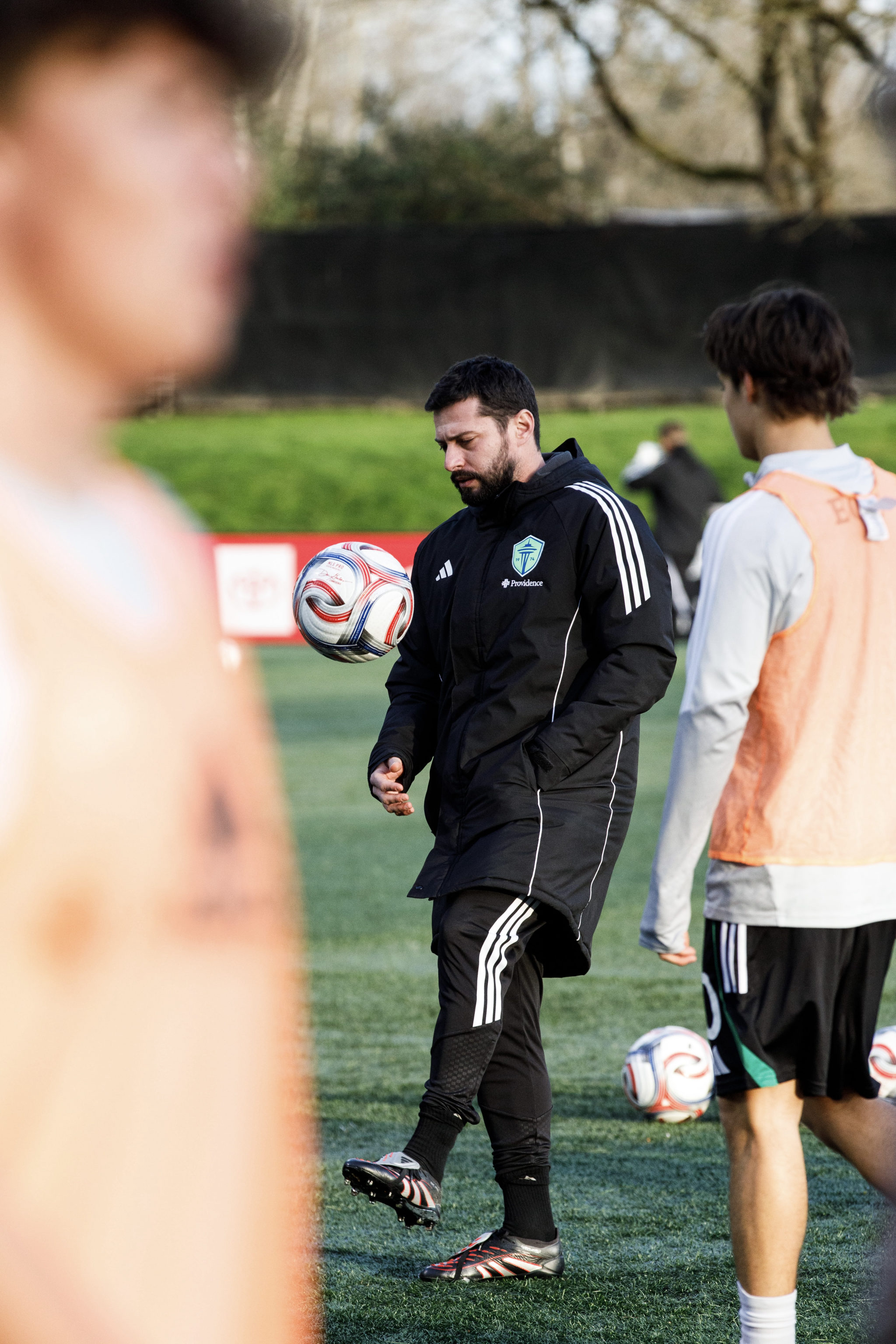


The latest Adidas World Cup ball is gaining attention as the tournament nears, but how does its design and legacy compare to its predecessors? Let’s rank every Adidas World Cup ball from worst to best to see how the Trionda measures up.
10. Telstar (Russia 2018)
Both this tournament and its respective ball can be criticised for being less memorable than the tournaments four years either side. The black, pixelated graphics on a white background made for a retro-futuristic look, a modern take on the original Telstar football from 1970. Whilst, in theory, this is a clean and distinctive design, its basic template left a lot to be desired for a 21st Century World Cup
9. Al Rihla (Qatar 2022)
Four years on from the Telstar, we had a World Cup ball with some colour. Named after the Arabic word for ‘journey’, this ball paid testament to Qatari culture, drawing inspiration from traditional Qatari art, architecture and even Dhow boats. The vibrant blues, reds and yellows made for a more exciting ball, reflecting the thrills of the tournament itself. However, the memories of Qatar, a few years on, heavily outshine the match ball, leaving little recollection or true nostalgia for an ultimately very basic design.
Here's a look back at the launch event of Al Rihla 👀
— Kaka (@KAKA) April 18, 2022
What do you guys think of the @adidasfootball World Cup ball?
/
Lembrando como foi o lançamento da Al Rihla 👀
O que vocês acharam da bola da Copa da @adidasfootball ?#adidasfootball #worldcup pic.twitter.com/bRsd1RvvOC
8. Telstar/Telstar Durlast (Mexico 1970, Germany 1974)
The first and second editions of the Adidas World Cup ball were something special. They may be basic by today’s standards and unimaginative compared to the modern-day match ball, but there is no doubt about the importance the original Telstar holds in football history. Arguably the most iconic football design of all time, with its 32 panels, 20 white hexagons and 12 black pentagons, the ball was revolutionary, enabling clearer viewing on the black and white TV screens of the time, cementing it as a true footballing innovation.
The inspiration for Adidas' first World Cup ball came from space - literally.
— FIFA Museum (@FIFAMuseum) January 22, 2019
The 1970 Telstar was named after the satellite, which not only closely resembled the ball's paneled design, but paved the way for 1970 to be the first World Cup to be broadcast on global television. pic.twitter.com/0doLNgrG3K
7. Tango Durlast, Tango España, Azteca, Etrusco Unico, Questra (Argentina 1978, Spain 1982, Mexico 1986, Italy 1990, USA 1994)
Adidas followed the Telstar with a new template that would last over a decade and span five World Cups. This design was more visually attractive, less rigid and more elegant. Firstly, the curved black details created an optical illusion of twelve circles when the ball was in motion. From 1986 onwards, each edition featuring the template differed to represent the World Cup it was assigned to appropriately.
For example, Mexico 1986 featured a unique Aztec-inspired pattern on its black features, Italy 1990 saw a ball designed with the Etruscan civilisation of central Italy in mind, and the match ball for 1994 USA was set apart by space-themed graphics that paid homage to the Apollo 11 moon landing 25 years earlier.
6. Tricolore (France 1998)
The curtain call for the classic ‘Tango’ template came in 1998, as the world prepared to enter the new millennium. This ball came with colour, the first World Cup ball to do so, hinting at vibrant things to come. An improvement and step forward from the previous footballs, the Tricolore still featured a similar design, with the addition of the three colours of the French flag, or Tricolore as it is called in France, making it a fitting name for the ball itself. The striking blue and subtle red made a now seemingly dated template seem more interesting: add patterns inspired by the French Gallic Rooster, and the result is a ball that is an extremely fitting representation of the tournament’s host country.
adidas Tricolore. The ball of the 1998 World Cup.
— Vintage Football Shirts (@VFshirts) November 20, 2024
⚽ pic.twitter.com/EL6pJvm71M
5. Trionda (USA, Canada, Mexico 2026)
The latest edition in this iconic series sits somewhere in the middle of the collection. Its design is bold and immediately striking, presumably an intended effect considering the build-up the 2026 tournament has been receiving from FIFA themselves.
It all starts with the ball ⚽️ !!#Trionda #FIFAWorldCup #createdwithadidas pic.twitter.com/Ox5TaRwpnL
— Casemiro (@Casemiro) October 3, 2025
Three distinct sections and three distinct colours for the three host nations: the blue component fits the US with a starry graphic, the red aptly represents Canada with its staple Maple Leaf imagery, and the green with the head of an eagle stands for Mexico, finishing off what is a symbolically rich football. Although quite basic in concept and potentially lacking in depth, it is certainly one that cannot be ignored, much like the increasing build-up to next year’s tournament…
4. Fevernova (Japan, South Korea, 2002)
Speaking of bold designs, the turn of the new millennium brought a new style of World Cup ball, with each tournament now having its own truly unique aesthetic, starting with the Fevernova in 2002. This was a radical departure from tradition, featuring a distinct design inspired by Asian calligraphy, a nod to the dual hosts of Japan and South Korea: the instantly recognisable deep red flame pattern is placed on a gold-and-green symbol, which also appears on the white background of the ball itself. It was a break from the World Cup convention, a step towards the future; it was still simply a new design printed on a familiar ball. This was all about to change…
The adidas Fevernova 🌟
— Classic Football Shirts (@classicshirts) November 6, 2023
The greatest ever World Cup ball? pic.twitter.com/vq0S8YKmr9
3. Teamgeist (Germany 2006)
In 2006, the design became the ball. 14 panels down from 32 made up the ball for the Germany World Cup, a revolutionary innovation brought together by thermal bonding for the first time, with fewer seams and a rounder shape, allowing for a smoother, more dynamic ball. A step into the future of footballing invention, the slick, futuristic design is now instantly recognisable and nostalgic; it was fittingly named the Teamgeist, or ‘team spirit’ in translation. The tournament and the ball did not disappoint, providing a glimpse of the modern footballing world. The ball was not without its criticisms. Its unpredictability in the air caused divided opinions - many loved it, some didn’t, but either way it was only a mere foreshadowing of the most controversial World Cup ball of all time…
Teamgeist is back 👀
— Classic Football Shirts (@classicshirts) March 20, 2025
adidas have released a new colourway for the Predators inspired by the 2006 World Cup ball. pic.twitter.com/FPOeX0T3Zy
2. Jabulani (South Africa 2010)
The title of the most controversial World Cup ball of all time, without a doubt, goes to the now-infamous Jabulani. Now down to only 8 panels, Adidas perhaps took it a step too far in creating the ‘perfect’ ball. An even smoother and more spherical ball than its predecessor, incredible flight was enhanced, and so was the ability for a knuckleball effect to be performed. It became a goalkeeper’s worst nightmare in 2010 - in fact, it became every player’s nightmare apart from Diego Forlan, who seemed to be able to master the ball to perfection and score some unbelievable goals on the African continent. The Jabulani (meaning ‘be happy’ in Zulu) drew inspiration from South Africa's diversity, with eleven colours representing the eleven players on a team, the eleven South African communities, and the eleven languages spoken in South Africa. Despite the controversy, this ball was stunning, and most importantly, it was fun. Controversial or not, everyone wants to play with a Jabulani at least once in their lives, and it certainly won’t be forgotten in a hurry…
Maradona y la Jabulani, esa pelota que tanto revuelo causó en Sudáfrica 🇿🇦 2010.pic.twitter.com/4HC6cBLDva
— VSports Team (@VSportsTM) December 12, 2025
Maradona reacts to the ball in South Africa, blaming it for much of Argentina's issues during the competition (Twitter / X)
1. Brazuca (Brazil 2014)
The perfect ball fit for an iconic tournament. The word Brazuca describes the national pride in the Brazilian way of life, a fitting name for the 2014 Brazil World Cup ball—a ball that its nation and even the world could be proud of and marvel at. This design had depth: the colourful ribbon-like patterns were inspired by multi-coloured wish bracelets worn by Brazilians, representing hope and good fortune, something the host nation had plenty of heading into the tournament. It was stunning technically, too, as six identical panels created a more symmetrical, stable ball, allowing it to overcome the issues of its predecessors. The setting, the ball, and most importantly, the goals scored with it live on in the memory of any football fan as the sport returned home in 2014. The Brazuca's elegance as it floated through the air and its immediate recognisability have made it not only a symbol of footballing artistry but also a lasting icon of the World Cup's spirit—undeniably the greatest World Cup football of all time.
Introducing @brazuca, the 2014 FIFA #WorldCup match ball! #allin or nothing. pic.twitter.com/CBMO3OtBR8
— adidas Football (@adidasfootball) December 3, 2013